'Mardi' as a satire of the Latter Day Saints


What to make of Herman Melville's Mardi... As one LDS scholar puts it, "That Melville could have used The Book of Mormon in writing Mardi is apparent." The island of Serenia in the novel could well be Nauvoo, or Joseph Smith’s utopian flights of fancy about what Nauvoo could have been after they drained the mosquito-ridden swamp.
Melville enjoyed all this mischief. There are many sly lines like "I now perceived that I might be a god as much as I pleased," which may have been a dig at Smith. The god of Serenia is named Alma, after the prophet in the longest book of The Book of Mormon and there is a parody of Mormon missionaries and their talk of paradise where everyone is a “brother.” Even the title of the novel means "Land of Men," which Nauvoo certainly was. All the main characters except for the hero seem to be converted to Mormonism by the end, and one, the philosopher of course, has visions of angels and the cosmos like Joseph Smith himself.
Melville's hero at the end of Mardi is on his own though, escaping through the gap in the reef, into the endless sea, like Odysseus escaping Calypso – Taji chasing the beautiful white captive Yillah. She is, we might say, more attractive than any white whale. Like Joseph Smith, distracted by beautiful women and dreams of Celestial Marriage, he is chasing a chimera.
The painting up top evokes Mardi but it's actually the Hudson River near where Melville lived for much of his life, not the South Seas. It is Gates of the Hudson, from 1891, the year Melville died,
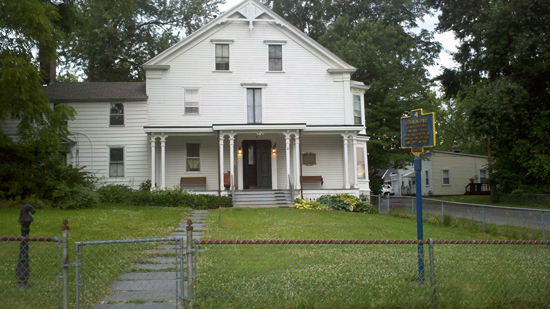
Below are the houses Melville lived in when he wrote his novels. The first is in Lansingburgh, the northern section of Troy, New York. The Hudson River is just across the street from this house (on the right of the photo). He lived there nine years until his marriage in 1847 and it is where he wrote Typee and Omoo. It is now the home of the Lansingburgh Historical Society.
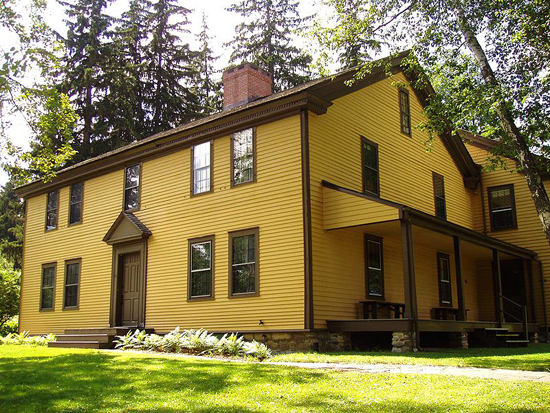
He wrote Mardi in New York City but, in 1850, Melville and his wife Elizabeth moved to Pittsfield, western Massachusetts, to the home below, which he knew as Arrowhead. They would live there for 13 years and have 2 sons and 2 daughters. Most of his famous books, including Moby-Dick were written here. It is now a museum run by the Berkshire County Historical Society.