The Freemasons


The Freemasons of the late 18th century were inspired by Rousseau's ideas, but the reverse is hardly true. Rousseau never would have tolerated their secrecy and their rituals, let alone their emphasis on improving oneself through the study of esoteric knowledge.
Nonetheless for his contemporaries, joining the Freemasons offered real advantages. This is why Goethe, Mozart, Franklin and Washington were among the many who joined lodges in the 1770s and 1780s, when they became the equivalent of the salons. These private clubs offered a way to meet aristocrats, artists and intellectuals away from the interference of the Church. Members only had to acknowledge the Great Architect of the Universe and they could engage in a frank exchange of ideas. They appreciated the religious tolerance, the spirit of brotherhood and the sense of a secret history dating back to antiquity. Mozart, for example, wrote music for Masonic ceremonies and infused it in The Magic Flute (1791).
No wonder the Christian churches were hostile, just as they were hostile to Jews. The two nasty strains later fused. The caricature below is from 1902.
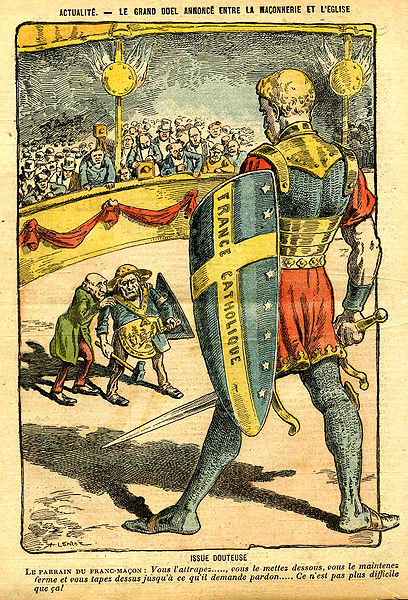
It is by French illustrator Achille Lemot and the Catholic warrior clearly has the advantage over the poor Freemason (Franc-maçon) in front of him who is receiving advice from his Jewish instigator, le parrain ("godfather").
This caricature appeared in the magazine Le Pèlerin ("pilgrim") which was produced by the Catholic order, the Assumptionists, from 1873 (and it's still around today). Back then its anti-Freemason and anti-Jewish messages flourished in the angry years of the Dreyfus Affair, hence the reference to asking for a pardon. The Dreyfus Affair lasted from 1894-1906.
The nastiness also drew on anti-homosexual sentiment, but with a difference: upper class homosexuality was kept a secret. In 2013, the French Ministry of Defense made public for the first time the entire secret dossier they had been used to prosecute Dreyfus, which had been sealed till now - it is accessible online. The excuse used for covering up the outright mendacity and forged documents used to convict Dreyfus turned out to be because two foreign spies in Paris wanted to cover up their activities and their torrid homosexual affair. It didn't even involve Dreyfus. For reasons of "decency," the public never learnt about the activity of the spies, Colonel Maximilian von Schwartzkoppen, a German military attache, and Lieutenant Colonel Alessandro Panizzardi, an Italian military attache.
It would all get worse in the Nazi era. This image is from 1935.
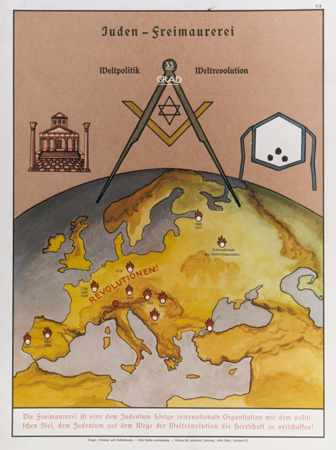
The text at the bottom reads, "Freemasonry is an international organization beholden to Jewry with the political goal of establishing Jewish domination through world-wide revolution." The Masonic symbols include the temple, square and apron, and the map shows where revolutions took place in Europe from the French Revolution in 1789 through the German Revolution in 1919.